Tech Jobs Aren't Dying. They're Moving.
Share this article
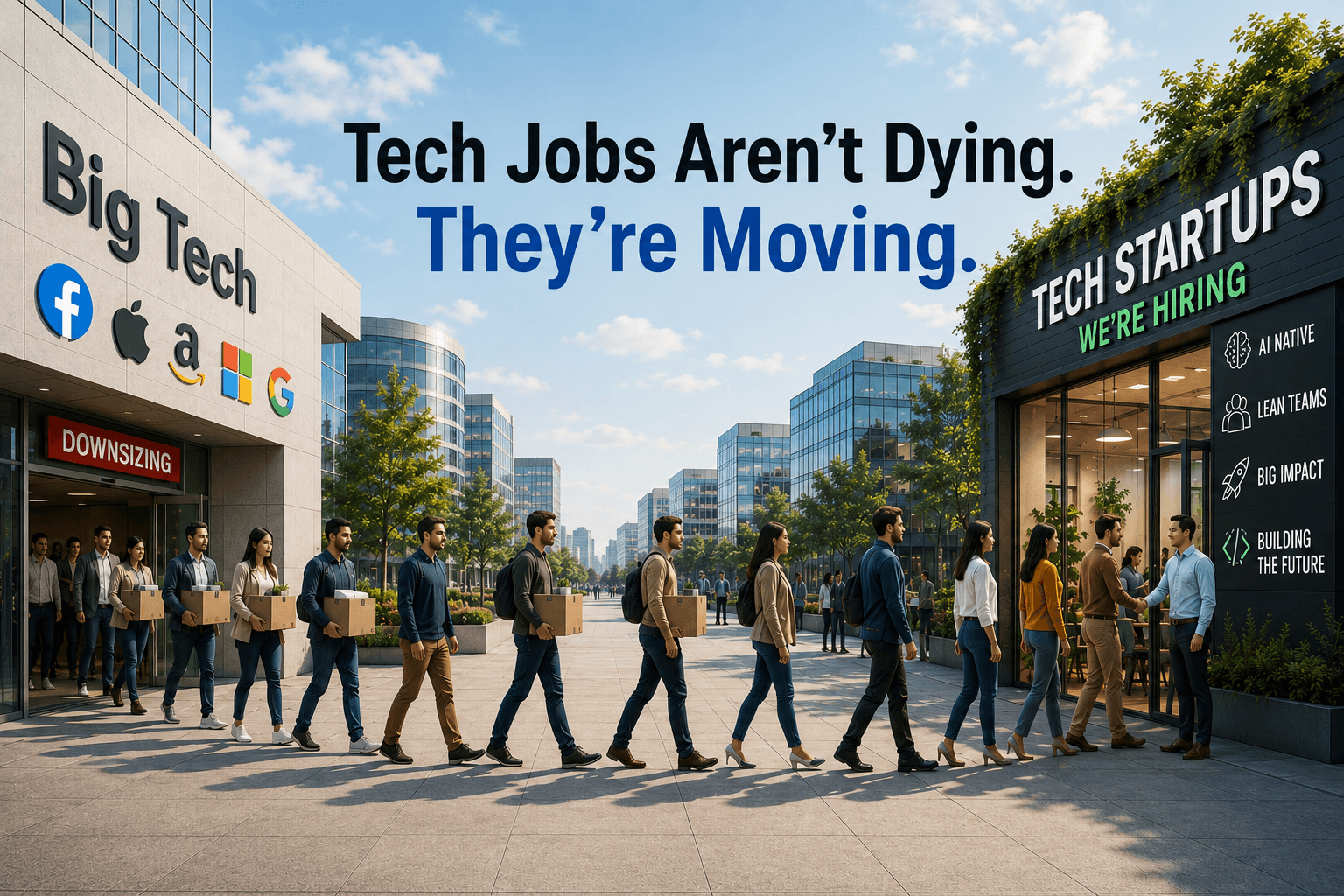

A Big Tech engineer gets laid off. An AI startup hires three more. The "AI is replacing software engineers" headline is missing the second half of the sentence.
If you've been following Twitter or LinkedIn lately, you've seen the same story rotated a dozen different ways: AI is coming for software engineers. Salesforce cuts. Meta cuts. Amazon cuts. Oracle just announced its largest layoff in company history. Through May 11, 2026, Layoffs.fyi has tracked ~103,571 tech layoffs this year, and TrueUp puts the number closer to ~128,000. Q1 2026 alone saw 52,050 cuts — the worst quarter since early 2023.
So here's the question that nobody is asking: if AI is replacing software engineers, why did US tech job postings just hit a three-year high?
CompTIA's May 8 Tech Jobs Report clocks 271,483 new tech postings in April alone, with software developer roles up 32.3% since January and AI engineer postings up 143% year over year — the fastest-growing job in America, per LinkedIn's Jobs on the Rise 2026.
How can that be?
The layoff trackers and the job-posting trackers are reporting the weather from very different office windows. Tech jobs aren't dying. They're moving.
The capital already moved
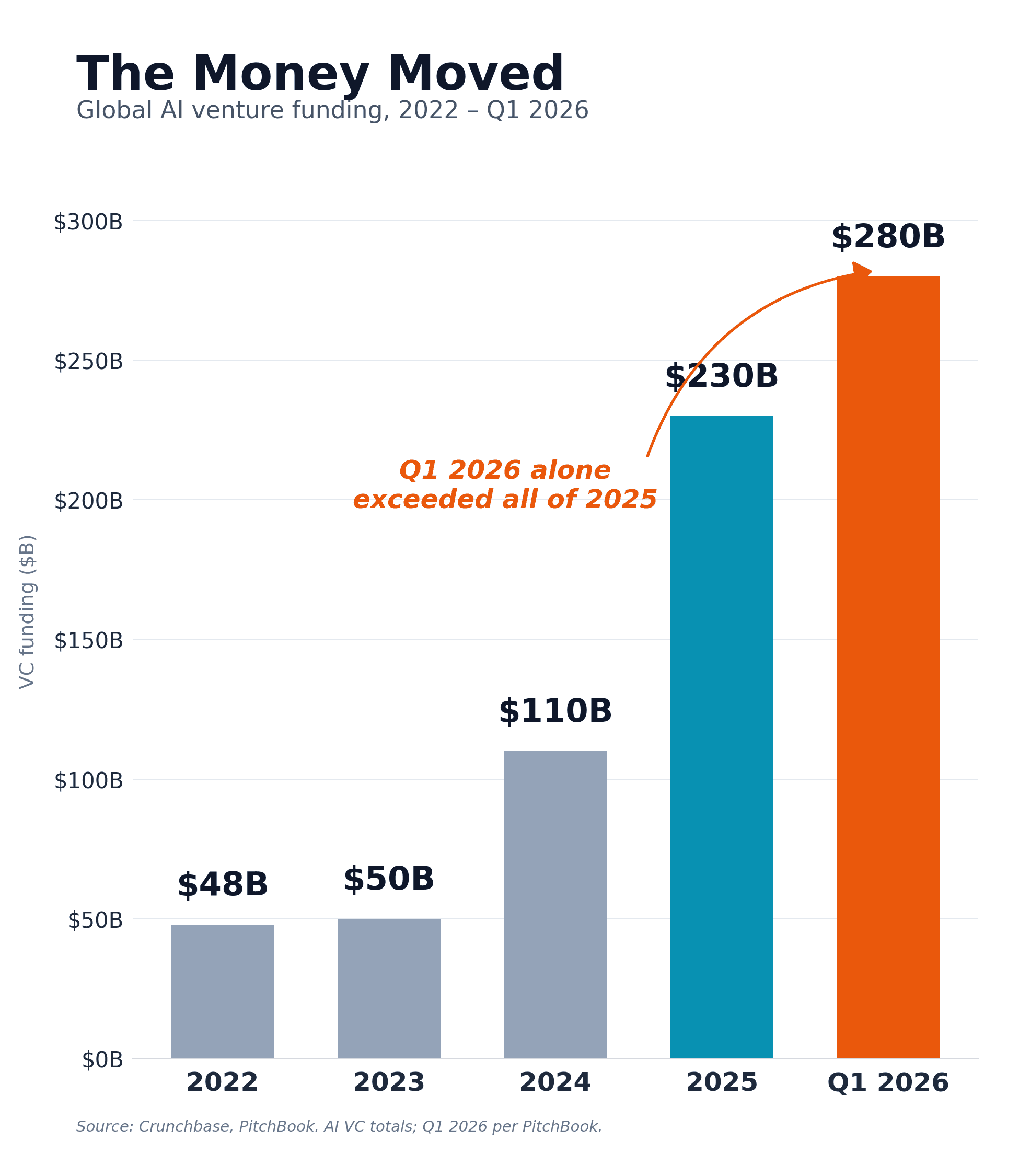
AI startups captured more than half of all global venture capital for the first time in 2025.
Start with where the money is. In 2025, AI startups raised between $192B (Crunchbase) and $270B (PitchBook) — more than half of all global venture funding for the first time in history. Then Q1 2026 alone exceeded the entire 2025 AI funding year.
The other side of that ledger: industry estimates put the largest tech companies' AI infrastructure spending at roughly $400 billion in 2025, and Meta sought $25 billion in a single bond sale to fund its AI build. Hyperscalers have already poured over half a trillion dollars into the rails. AI-native startups are the trains that run on these rails.
Capital this size doesn't sit in a bank. It hires.
| Company | ~2024 headcount | April 2026 headcount |
|---|---|---|
| OpenAI | ~3,500 | ~4,500 (targeting 8,000 by EOY) |
| Anthropic | ~500–700 | ~5,000 |
| Perplexity | ~50 | ~500 |
| Cursor (Anysphere) | ~20–40 | ~200–400 |
| Sierra | ~50–100 | ~300+ |
| Harvey | ~150 | ~500 |
| Glean | ~500 | ~1,528 |
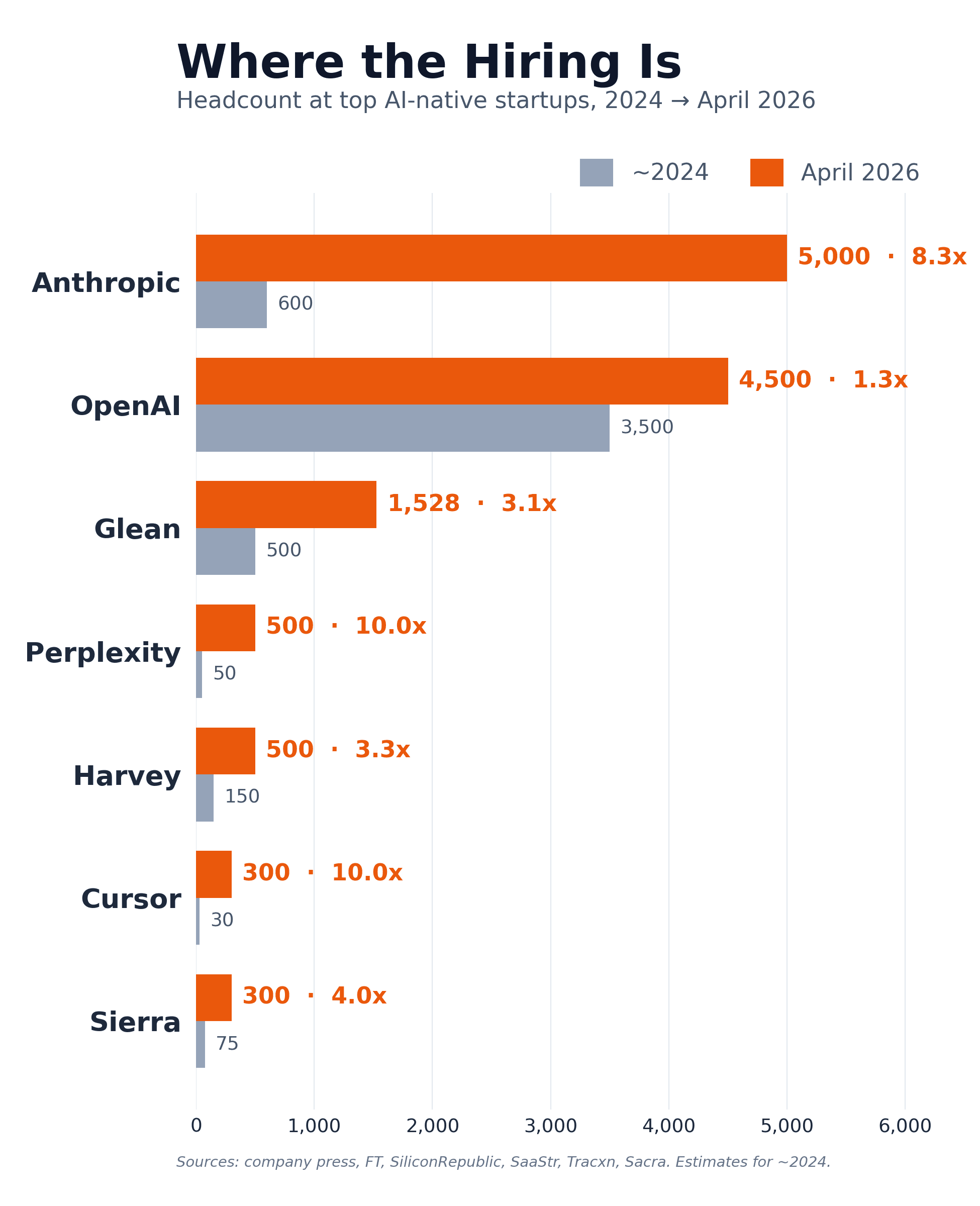
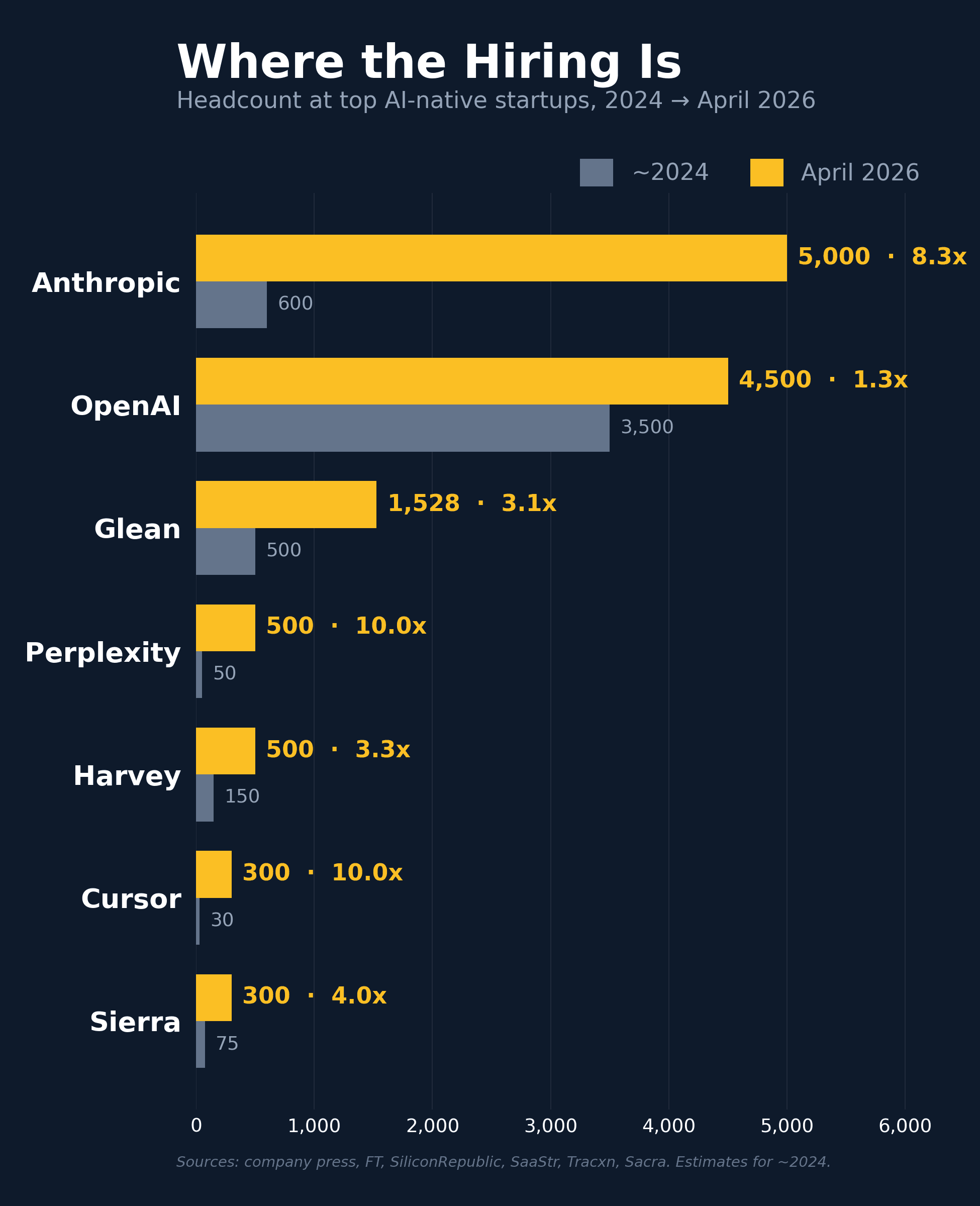
OpenAI's headcount alone has grown 10x since 2023.
OpenAI's headcount alone has grown 10x since 2023. Anthropic is now generating roughly $9 million in revenue per employee — for context, Google didn't hit that ratio until it was a decade old and trading publicly.
Meanwhile, Big Tech is moving in the opposite direction. Marc Benioff said the quiet part out loud last September: "I've reduced it from 9,000 heads to about 5,000, because I need less heads." Meta is cutting another 8,000 starting May 20. Microsoft just offered a voluntary buyout to 7% of its US employees. Oracle is letting 30,000 people go to free $8–10 billion a year for AI data center capex.
The long tail is where real hiring is happening
It's tempting to read this story as "OpenAI and Anthropic are gobbling up talent." That's the obvious half. The non-obvious half — the one nobody's writing about — is the long tail of two-to-four-year-old AI startups that have crossed $50–200M ARR in the last twelve months and are quietly hiring at 3–10x the rate of their Series A headcount.
55 US AI startups raised $100M in funding in 2025. Of those, more than half are under three years old. That's not a "two-company race." That’s a category quietly producing a new contender every six days. And it’s full of companies most of us haven’t targeted yet:
- Lovable became the fastest software company in history to $100M ARR (eight months from launch). The team is ~45 people. It will be 200+ by year-end.
- Cursor (Anysphere) went from a few dozen people to roughly $2B ARR with a team that's still under 400.
- Decagon (~$35M ARR, AI customer support) went from under 100 to ~340 employees in eighteen months and is hiring across forward-deployed engineering and applied AI.
- Sierra (AI customer-service agents) just crossed $150M ARR and 300+ employees. Hiring agent and infrastructure roles weekly.
- Glean (enterprise AI search, ~$200M ARR) is at ~1,528 employees and growing — and just opened a forward-deployed engineering org from scratch.
- Mercor (~$50M ARR, AI-native talent marketplace) tripled headcount in 2025.
- Crosby Health, Abridge, OpenEvidence (vertical AI in healthcare) — each adding 50–150 engineers in 2026.
- Harvey (legal AI, $100M+ ARR) tripled from 150 to ~500 employees.
- Cognition (makers of Devin, an autonomous AI coding agent) — engineering team is still under 100 against meaningful revenue.
- ElevenLabs ($330M+ ARR, voice AI) — under 200 people and aggressively hiring infra and research.
This is the part of the curve that TechStartups.ai is built to surface. Household names get press releases. But the next twenty companies behind them — the ones at $20–150M ARR, 50–500 people, raising Series B and C — are where the most leverage exists for an employee joining today. Earlier equity. Higher slope. Less internal bureaucracy.
Salary numbers prove it
If you want to know which way gravity is pulling, look at compensation. Five years ago, a Google L6 was the ceiling. Today that ceiling lives at startups — and so does the floor.
Most coverage of AI comp focuses on total comp, which gets dismissed as "paper equity." So let's start with the part that isn't:
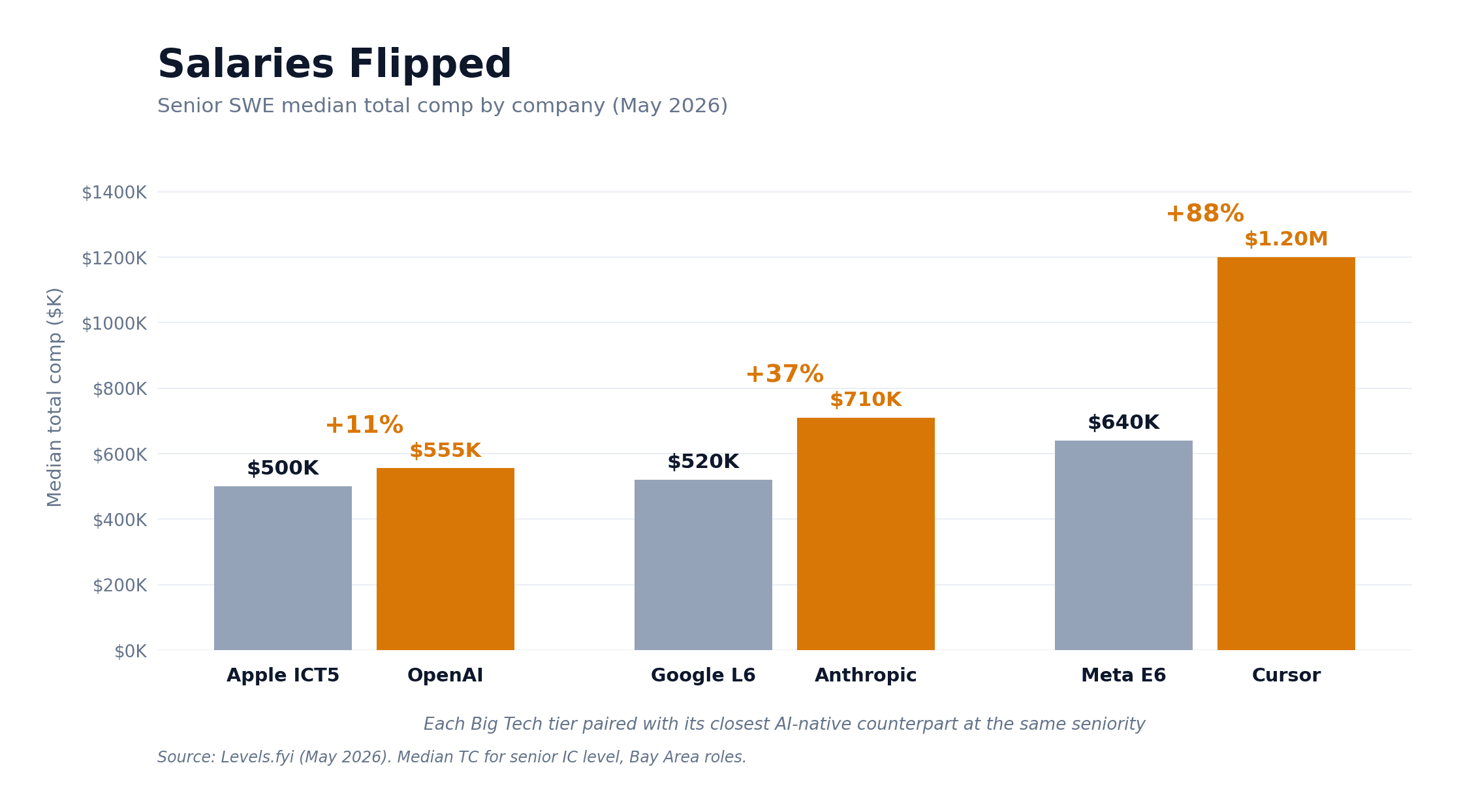
Base salaries at top AI startups are now higher than Big Tech base for the same level. Per Levels.fyi (May 2026), at the senior IC tier:
- Google L6 base: ~$240–280K
- Meta E6 base: ~$245–285K
- Apple ICT5 base: ~$230–275K
vs.
- OpenAI base for senior SWE: ~$310–385K
- Anthropic base: ~$300–375K
- Cursor base: ~$300K+ before equity
That's roughly $50–100K more in cash, before a single share of equity vests. AI startups aren't just winning the comp war on paper — they're winning it in cash.
Then the total comp numbers compound from there:
- OpenAI software engineers (Levels.fyi): median total comp $555K, max $1.38M.
- Anthropic SWEs (Levels.fyi): median $710K.
- Cursor SWEs: $1.1M–$1.28M+.
- OpenAI 2025 average stock-based compensation: $1.5 million per employee — the highest of any tech startup in history, per WSJ.

And it's not just the frontier labs. Levels.fyi data for the long tail — Sierra, Glean, Harvey, Decagon, Mercor — shows senior IC base salaries clustering at $240–320K with ownership-level equity on top. That's a Big Tech base with breakout upside.
The clincher is the cross-company flow data from SignalFire's 2025 State of Tech Talent: engineers are 11x more likely to leave Google DeepMind for Anthropic than the other way around. Talent isn't flowing back to incumbents. It's circulating over to AI-native startups.
So where should you actually go?
If you're looking for opportunities and reading this in May 2026, the practical map looks like this:
The jobs are at AI-native startups — and most of them aren't household names like OpenAI. The leverage is in the long tail: Cursor, Sierra, Glean, Decagon, Harvey, Lovable, Mercor, Cognition, ElevenLabs, Abridge, OpenEvidence, Crosby Health, and the dozens of $50–200M ARR companies behind them. All of them are hiring.
The roles are specific. Forward-Deployed Engineer postings are up roughly 800%. Agentic AI engineer roles, RAG and eval specialists, AI infrastructure, fine-tuning engineers. Job titles that didn't exist in 2022 are the ones with a 3-to-1 demand-to-supply ratio.
The place is San Francisco. In Q1 2026, the SF metro captured 66% ($176.1B) of all US venture capital, and the Bay Area as a whole got ~83% ($220.8B). Only 26% of AI engineer roles on LinkedIn are remote. Frontier tech companies are betting on everybody sitting side by side.
The headlines got it wrong
"AI is replacing software engineers" is an easy story to digest. It fits in a tweet. It generates clicks. And it hides a far more interesting reality, which is that the workforce is being reallocated, not eliminated — pulled out of Big Tech public companies and pushed into capital-rich private ones that are building the actual frontier.
Big Tech laid off 103,000 people this year so far. And AI startups raised a quarter-trillion dollars in three months. These are not competing facts. They're the same fact, viewed from opposite angles.
If you're looking for opportunities, the call is straightforward: stop reading layoff trackers and start reading funding announcements. That is where we live now.
TechStartups.ai tracks the next generation of AI-native startups absorbing talent that's leaving Big Tech — including the long tail of $50–200M ARR companies which most engineers haven't heard of yet.